






Hemorrhoid Artery Embolization in Maryland

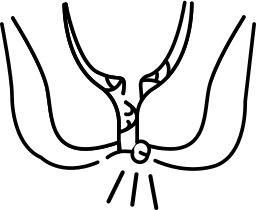
Internal hemorrhoids are swollen vascular cushions inside the lower rectum that bleed when arterial pressure exceeds what the surrounding veins can drain. Dietary changes, medication and banding manage the tissue. They do not reach the blood supply driving the problem. When bleeding persists despite all of that, hemorrhoid artery embolization goes to the source, reducing arterial inflow from inside the bloodstream without an incision in the anal canal, without general anesthesia and without a hospital stay. If you are searching for hemorrhoid artery embolization, VascuHealth offers same-week appointments at our clinic.

0 +
Years of Medical Training
0 +
Minimally Invasive Treatments
0 +
Procedures Performed Safely
0 %
Same-Day Outpatient Discharge
WHY VASCUHEALTH

Why You Need an HAE Specialist, Not a General Practitioner

Navigating a catheter to the superior rectal arterial branches, reading a live angiogram in real time and placing embolic agents at the correct vessel depth is fellowship-level work. Our physician earned his medical degree from George Washington University School of Medicine and completed his fellowship at Christiana Care Health System, where he developed advanced expertise in vascular and interventional radiology. He performs every HAE procedure personally at VascuHealth with no handoffs and no referrals between departments at any stage of your care.

Is HAE Right for You

Five Clinical Situations Where Hemorrhoid Artery Embolization Is the Right Next Step

HAE is indicated when standard care has not produced lasting resolution. If any of the five situations below reflects where you are right now, your case warrants a formal evaluation at VascuHealth.

When Conservative Treatment Has Not Stopped Your Bleeding

Dietary adjustment, fiber supplementation and topical medication work at the tissue surface. What they cannot do is reach the arterial vessels supplying your hemorrhoidal tissue from the inside. When your bleeding continues despite months of correct management, we target the inflow those treatments were never designed to reach.

Ongoing bleeding after conservative care points to unresolved arterial inflow as the root cause

Grade 2 and 3 internal hemorrhoids with active bleeding are the strongest HAE candidates

Conservative treatments do not reach the vessels supplying your hemorrhoidal tissue from the inside

Same-week evaluation available at our clinic

Why Your Hemorrhoid Bleeding Returns After Banding

Banding cuts off local circulation at the canal level but does not reach the arterial inflow arriving from the superior rectal vessels above. With a recurrence rate of 15 to 60 percent, bleeding returns because that upstream supply was never interrupted. HAE operates exactly at that level, which is why it resolves cases where banding has not.

Bleeding recurrence after ligation indicates persistent arterial supply above the treatment site

HAE accesses the superior rectal vessels that transanal procedures cannot reach

Prior rubber band ligation does not affect your eligibility for embolization

We perform HAE as a same-day outpatient procedure with no hospital admission required

A Non-Surgical Path to Lasting Hemorrhoid Relief

Hemorrhoidectomy carries a two-to-six week recovery, considerable post-operative pain and documented risks including sphincter injury and wound complications. If you are on anticoagulants, managing other health conditions or unable to accommodate that recovery, HAE delivers comparable lasting relief without general anesthesia, without a rectal wound and without surgical downtime.

If you cannot safely pause anticoagulation, you are an appropriate HAE candidate

We create no anorectal incision, eliminating the wound-related complications that follow hemorrhoidectomy

Your hemorrhoidal cushions and sphincter anatomy remain completely undisturbed throughout

Most patients return to sedentary work the morning following the procedure

When Transanal Procedures Have Not Resolved Your Symptoms

Sclerotherapy, infrared coagulation and Doppler-guided ligation are each applied from within your anal canal. None interrupt the superior rectal arterial supply arriving from above. If multiple office procedures have not produced lasting relief, we reach the vascular anatomy those treatments could not access and resolve the problem there.

Grade 1 to 3 hemorrhoids that have failed all transanal office procedures are the primary HAE indication

Prior sclerotherapy or infrared coagulation does not exclude you from embolization candidacy

HAE operates above the anatomical level where every canal-based office procedure is applied

We confirm your candidacy at consultation before scheduling anything

Still Bleeding After Every Treatment? We Address What Prior Care Has Not.

If you have exhausted every standard option and your symptoms persist, we evaluate your specific presentation, identify what has not been addressed and act on it. Same-week availability at VascuHealth.

ABOUT THE PROCEDURE How the Hemorrhoid Artery Embolization Procedure Works
ABOUT THE PROCEDURE

How the Hemorrhoid Artery Embolization Procedure Works

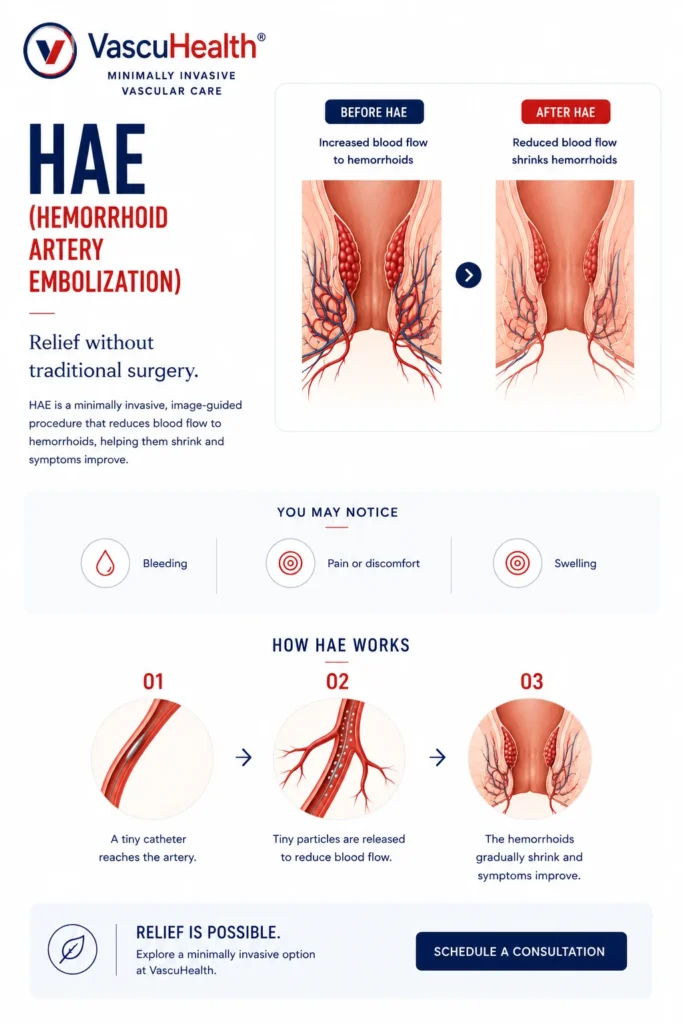
Your hemorrhoids bleed because the superior rectal arteries feeding them deliver more blood than the surrounding veins can handle. That pressure builds, vessel walls stretch and bleeding begins. HAE addresses this directly. We guide a thin catheter through a small access point at your wrist or upper thigh under live X-ray, place tiny coils and microsphere particles inside those arteries to reduce inflow and never enter your anal canal or approach your sphincter. Your tissue shrinks over the following weeks and bleeding resolves. Published studies confirm a technical success rate of 93 to 100 percent, with symptom improvement in 93 percent of patients at one-month follow-up.

YOUR HAE AT VASCUHEALTH

Your Hemorrhoid Artery Embolization From First Visit to Full Recovery

HAE is a single outpatient session with no staged treatment course and no hospital admission at any point. Here is what each stage involves at VascuHealth.

Consultation Preparation The Procedure Recovery Results

CONSULT (1)
Reviewing Your History and Confirming Your HAE Candidacy
We go through your full hemorrhoid history, prior treatments and current symptom pattern. We review any existing imaging or endoscopic findings alongside your clinical presentation. You leave knowing whether HAE is the right path for you and, if it is, with a confirmed procedure date.

PREPARATION (3)
What You Need to Do Before Your HAE Procedure
Fast from midnight the night before and arrange transport home as we use moderate sedation. No bowel preparation, no hospital pre-admission and no general anesthesia preparation is involved. We review your medications at consultation and advise on any temporary holds required beforehand.

PROCEDURE (5)
How We Perform Your Hemorrhoid Artery Embolization
We place a catheter through a small access point at your wrist or upper thigh and advance it under continuous fluoroscopic imaging to the superior rectal vessels supplying your hemorrhoidal tissue. Contrast dye confirms which arteries are involved. We place coils and microsphere particles inside those vessels to reduce your arterial inflow. We do not enter your anal canal and we do not approach your sphincter at any point. The session runs between 45 minutes and two hours.

RECOVERY (9)
What to Expect After Your Hemorrhoid Artery Embolization
We monitor you for one to two hours before you go home. You may experience mild discomfort at the catheter entry site for a day or two, which resolves with standard oral pain relief. Sedentary work is appropriate the following morning. We review and clear physical activity at your follow-up, typically within one to two weeks.

RESULT
How and When Your Symptoms Improve After HAE
Bleeding reduction is typically noticed within one to two weeks as arterial inflow decreases. Your tissue shrinks over one to three months as the treated vessels close. We confirm your treatment response at follow-up through clinical assessment and imaging where needed. If residual arterial activity is identified, repeat embolization remains an option.

Our Clinical Standard

The VascuHealth Standard for Hemorrhoid Artery Embolization in Maryland

Placing embolic agents inside the rectal arterial branches requires precise catheter navigation at small vessel level, live angiographic interpretation and the clinical judgment to confirm a clean endpoint. Dr. Nwosu holds ABR board certification in vascular and interventional radiology and maintains active membership in SIR, RSNA, VIVA and OEIS. If you are searching for hemorrhoid artery embolization in Maryland, we deliver that standard at outpatient level from our clinic with same-week scheduling and no referral required.

TESTIMONIAL

What Our Patients Say After Hemorrhoid Artery Embolization at VascuHealth

Years of bleeding, prior failed procedures and no interest in surgery. Here is what changed after HAE at VascuHealth.

FAQS

Frequently Asked Questions

How does the hemorrhoid artery embolization procedure differ from rubber band ligation?
Banding cuts off local blood supply to a specific segment of your hemorrhoidal tissue from inside the anal canal. The hemorrhoid artery embolization procedure works from inside your bloodstream, reducing arterial supply to your entire hemorrhoidal plexus from above. That upstream reach is why it resolves cases where ligation has already been attempted without lasting success.
Is hemorrhoid artery embolization painful?
We perform the procedure under local anesthesia and moderate sedation. Because we do not enter your anal canal at any point, the discomfort associated with transanal procedures does not apply to you. You may experience mild soreness at the catheter entry site for a day or two afterward, which settles with standard oral pain relief.
What is your recovery period after HAE?
You go home the same day. You can return to sedentary work the following morning. We review and clear strenuous activity and heavy lifting at your follow-up visit, typically within one to two weeks of your procedure.
Does insurance cover hemorrhoid artery embolization?
We accept Medicare, Medicaid and most major insurance plans at VascuHealth. Your coverage depends on your specific plan and your documented clinical history. We verify your benefits before confirming your procedure date so you have no uncertainties on the day.
What happens if your bleeding returns after HAE?
Repeat embolization is a clinically viable option and has produced strong outcomes for patients who needed a second session. HAE also does not affect your eligibility for surgical hemorrhoidectomy if that becomes the right path later. We review your treatment response at follow-up and discuss next steps based on your findings.

Visit Our Clinic

Book Appointment

Take the First Step and Book Your Consultation Today

About Us

At Maxcare, we are dedicated to delivering exceptional healthcare with compassion, innovation, and integrity. For over 20 years, we have been a offering comprehensive medical services in USA

Contact Info

231 Utah City Centre, Utah, USA