







Dialysis Access Management in Maryland
To receive dialysis, your body needs a reliable entry point, usually a fistula or graft in your arm, that allows blood to move in and out of the machine quickly enough to be properly cleaned. When that access starts narrowing or blocks completely, your treatment suffers and your schedule gets disrupted. Staying on a temporary catheter while you wait is not a safe long-term solution. At VascuHealth, we perform outpatient dialysis access management to restore and protect your access before it reaches that point, working alongside your nephrology team and keeping everything at clinic level without a hospital admission.
AV Dialysis Access Management by One Physician Who Knows Your Full Picture
When your access develops a problem, you need someone who reads your imaging personally, fixes the issue and stays in contact with your nephrology team without sending you through multiple departments first. Our physician earned his medical degree from George Washington University School of Medicine and completed his fellowship at Christiana Care Health System, where he developed advanced expertise in vascular and interventional radiology. He reviews every scan himself, performs every procedure personally and coordinates directly with your care team throughout. One physician responsible for your access from the moment a problem is identified to the moment your treatment is back on track.
Five Signs Your Dialysis Access Needs Attention Now
Your dialysis unit monitors your access at every session but problems can develop between visits. These are the five situations that need prompt evaluation at VascuHealth.
-
Reduced Flow During Dialysis -
Loss of Thrill or Bruit -
Clotted or Non-Functional Access -
Fistula That Has Not Matured -
Dysfunctional Tunneled Catheter
Your Machine Keeps Alarming and Your Sessions Feel Incomplete
Repeated flow alarms may indicate that your vascular access is not allowing blood to flow at the rate needed for effective dialysis treatment. This can happen when the blood vessel has narrowed at some point along the access pathway. In many cases, a straightforward procedure can restore proper flow and help reduce the risk of clot formation.
Repeated flow alarms indicate your access is narrowing and needs immediate evaluation
Poor flow directly affects how well your dialysis works each session
Opening the narrowed section restores full flow in a single outpatient visit
Same-week evaluation scheduled around your existing dialysis appointments
The Vibration Over Your Fistula Has Faded or Stopped
A steady vibration over your fistula means blood is moving through it properly. When that feeling weakens or disappears, flow has slowed significantly. Coming in at this point gives us the best chance of a straightforward resolution before the access clots entirely.
A fading or absent vibration means blood flow through your access has dropped
Early evaluation gives us the best chance of restoring function before things worsen
We begin with an imaging scan to identify exactly where the problem is
Acting early keeps your access working and your dialysis schedule uninterrupted
our Access Has Stopped Working but Surgery Is Not Always the Answer
A blocked fistula or graft does not automatically mean surgery. We deliver clot-clearing medication directly into the vessel and use a small device to remove what remains. Flow is confirmed through imaging before you leave and most patients are back on their dialysis schedule the following day.
A blocked access can often be cleared without surgery using targeted medication and a small device
Flow is confirmed through imaging before your procedure is complete
Most patients return to their normal dialysis session the day after treatment
Clearing the access avoids the complications that come with staying on a temporary catheter
Your New Fistula Is Not Developing as It Should
Around one in four newly created fistulas needs an intervention before it becomes usable for dialysis. A narrowing inside the vessel is limiting the blood flow needed for it to grow. We locate that narrowing, open it and allow the fistula to develop properly.
About one in four new fistulas requires a procedure before it can support dialysis
A narrowing inside the vessel is the most common reason development stalls
Opening that narrowing allows the fistula to grow strong enough for use
We coordinate with your surgeon and nephrologist throughout the maturation process
Your Tunneled Catheter Is Underperforming During Sessions
A catheter placed while your fistula develops can shift, become partially blocked or simply stop working well. Every compromised session raises your infection risk. We fix, reposition or replace it as an outpatient procedure and remove it once your permanent access is confirmed ready.
A catheter that underperforms during dialysis raises your infection risk with every session
Repositioning or replacing it under imaging guidance restores function the same day
We remove it once your permanent access is confirmed working and ready to use
Everything is coordinated with your nephrology team to avoid gaps in your treatment
Access Problem Flagged by Your Dialysis Unit? We See You This Week.
Missing dialysis is not an option. We work directly with your nephrology team across Maryland, offer same-week availability and handle everything at outpatient level so your schedule stays intact.
How We Restore and Maintain Your Dialysis Access
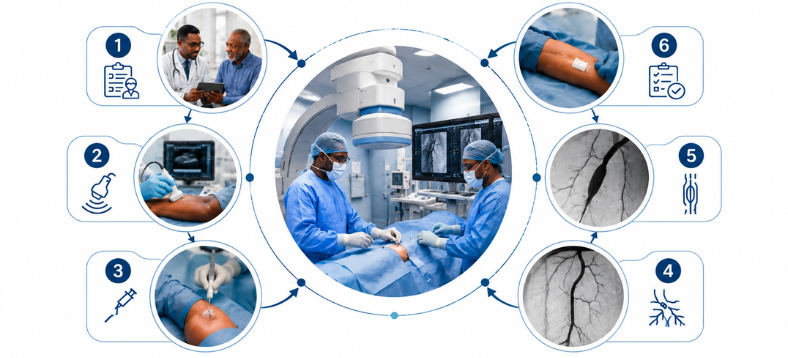
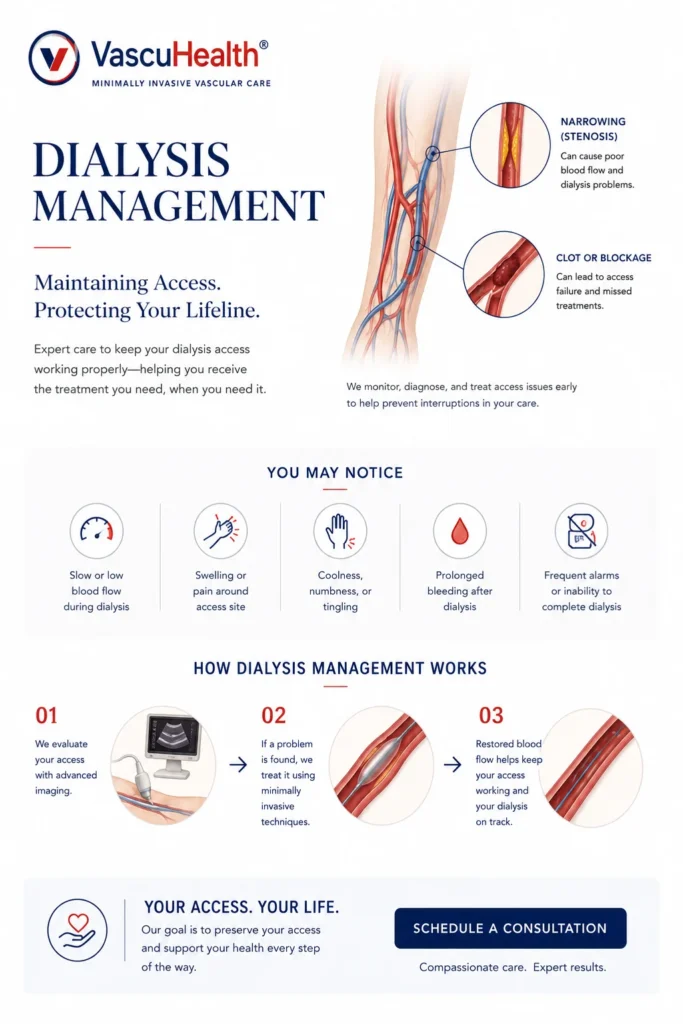
We begin with a fistulogram, a short imaging scan that shows us exactly where your access has narrowed or blocked. From there we proceed based on what we find. A small balloon opens the narrowed section, a stent holds it open if the vessel keeps closing or medication and a small device clears a clot and restores flow. Clinical studies confirm these procedures restore adequate dialysis blood flow in over 90 percent of cases. Most visits take between 30 and 60 minutes and you go home the same day.
What Your Dialysis Access Management Looks Like From First Contact to Follow-Up
HAE is a single outpatient session with no staged treatment course and no hospital admission at any point. Here is what each stage involves at VascuHealth.
The VascuHealth Standard for Dialysis Access Management in Maryland
Identifying the right problem on an access scan and fixing it precisely takes fellowship-level interventional radiology training. Dr. Nwosu holds ABR board certification in vascular and interventional radiology and maintains active membership in SIR, RSNA, VIVA and OEIS. For dialysis patients searching for a dialysis access management center in Largo, that level of care is available at outpatient level with same-week scheduling and direct access to the physician who treats you.
What Our Patients Say After Dialysis Access Management at VascuHealth
A blocked access, a disrupted schedule and no interest in surgery. Here is what changed after care at VascuHealth.
Gloria Patterson
Harold Jefferson
Patricia Clarke