







Prostate Artery Embolization (PAE) in Maryland
An enlarged prostate, also known as benign prostatic hyperplasia (BPH), is a common condition that affects many men as they age, placing pressure on the urethra and leading to symptoms such as frequent urination, nighttime bathroom trips, urgency, weak urine flow, incomplete bladder emptying, and disrupted sleep. Medications may help manage symptoms and surgery is often recommended for severe cases, but neither is your only option. At VascuHealth, we offer Prostate Artery Embolization (PAE), a minimally invasive treatment that reduces prostate size by decreasing its blood supply, performed at our outpatient clinic in Largo, Maryland.
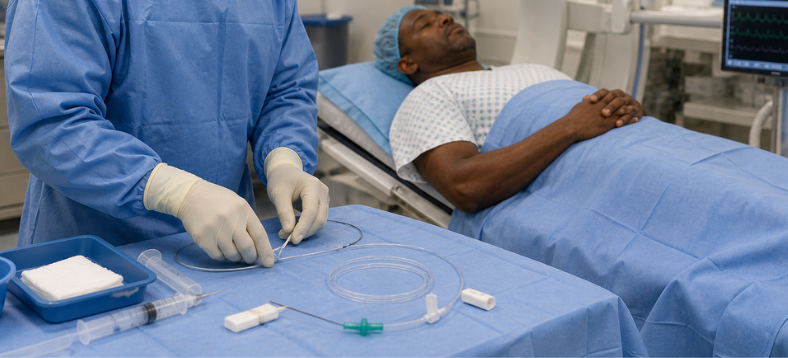
Using advanced image-guided technology, we treat the enlarged prostate through a tiny catheter, without surgical incisions or removal of prostate tissue. Most patients return home the same day and resume normal activities much sooner than with conventional surgical procedures.
Who Performs Your PAE at VascuHealth?
Multisociety and multidisciplinary position statement endorses prostate artery embolization as a valuable minimally invasive option in patients who cannot tolerate or who have failed medical therapy, as well as those who are poor surgical candidates or refuse invasive surgery. The procedure is performed by our fellowship-trained interventional radiologists. Our founding physician holds that credential and built VascuHealth so men in Maryland no longer need to travel to a DC or Baltimore hospital system to access this standard of care. Your physician is with you at consultation, at your procedure and at follow-up. Every time..
Is Enlarged Prostate Non-Surgical Treatment Right for You?
We perform PAE treatment for men with moderate to severe BPH who want lasting relief without surgery, a hospital stay or the side effects that follow. These are the five situations where it fits best.
-
Medication Stopped Working -
Avoiding Surgery -
Large Prostate
-
Prior Treatment Did Not Hold -
Surgery Is Not Safe for You
Treat the Prostate, Not the Symptom
BPH medication manages symptoms but does not reduce your prostate. If six months or more of treatment has not brought lasting relief, the underlying cause has not been addressed. PAE treatment reduces the gland directly so you are not dependent on a daily pill to function normally.
Medication masks BPH symptoms without shrinking the prostate
PAE treatment reduces the gland, not just the discomfort
Enlarged prostate non surgical treatment that targets the cause
PAE reduces prostate volume so your bladder empties fully and consistently
Same-Day. No Hospital. No Catheter.
Prostate artery embolization is performed under local anesthesia and light sedation at our outpatient clinic. No overnight admission, no surgical recovery period and no catheter to manage when you get home.
Prostate artery embolization performed under local anesthesia only
No overnight admission, no catheter, no surgical recovery
PAE treatment completed and home the same afternoon
Sexual function and continence are preserved throughout the PAE procedure
No Upper Size Limit
Certain surgical BPH options lose effectiveness as prostate volume grows. Prostate artery embolization has no upper size threshold. We treat significantly enlarged glands with consistent outcomes regardless of prostate volume, confirmed through your imaging at consultation.
Prostate artery embolization works at any prostate volume
Surgical options lose effectiveness as gland size increases
PAE treatment delivers consistent outcomes regardless of prostate size
Prostate volume confirmed through imaging at your consultation
A Different Approach Entirely
If a previous BPH procedure brought relief that did not last, PAE works through a fundamentally different mechanism. We access the prostate through its arterial supply rather than through the urethra, which makes it a valid option even when other interventions have already been tried.
PAE accesses the prostate through arterial supply, not the urethra
Prostate artery embolization viable after failed prior BPH procedures
A fundamentally different mechanism when other treatments have not held
PAE treatment reviewed against your full intervention history at consultation
Local Anesthesia Only
If you are on blood thinners, carry a cardiac history or have been assessed as too high a risk for general anesthesia, PAE treatment is still a viable option. The risk profile is substantially lower than TURP or open prostatectomy and your physician reviews your full history before any plan is confirmed.
PAE treatment performed under local anesthesia, no general anesthesia
Safe option for patients on blood thinners or with cardiac history
Substantially lower risk profile than TURP or open prostatectomy
We review your full medical history before any plan is confirmed
Book a Consultation with a PAE Specialist This Week!
Men across Maryland, Northern Virginia and the Washington, DC metro area come to VascuHealth when medication has plateaued or surgery is the only option they have been offered. We see patients Monday through Friday. Call our clinic or book directly online.
How Prostate Artery Embolization (PAE) Works
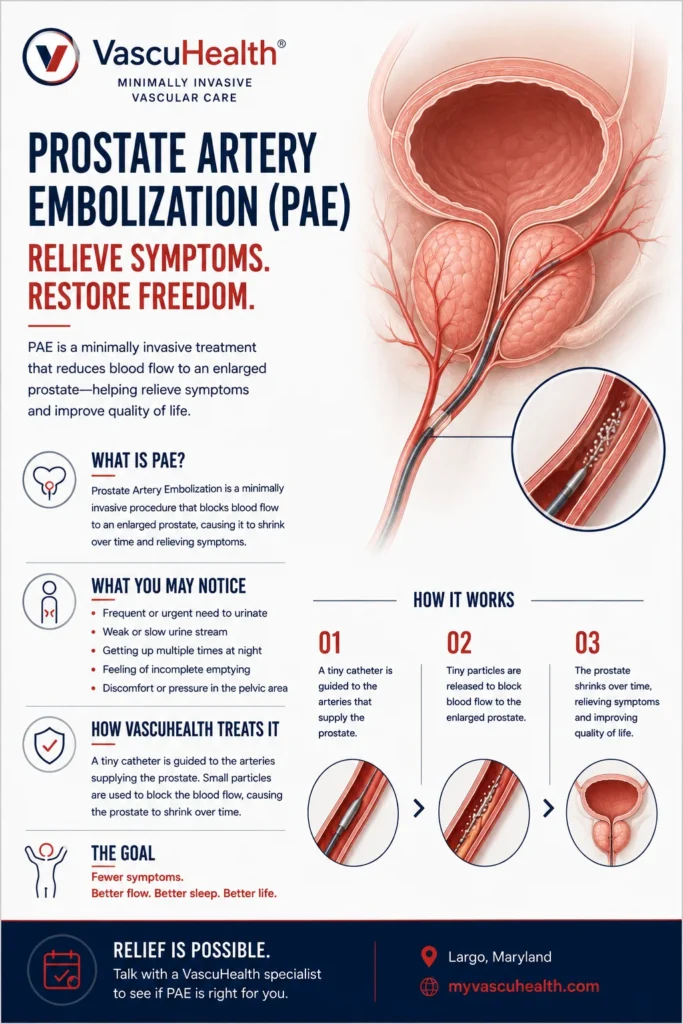
An enlarged prostate (BPH) causes urinary symptoms because the growing gland presses against the urethra and restricts the normal flow of urine. Prostate Artery Embolization (PAE) is a minimally invasive treatment that reduces the size of the prostate without surgery. At VascuHealth, we perform PAE using advanced image-guided technology in our outpatient clinic in Largo, Maryland, inserting a small catheter through a tiny opening in the wrist or groin and guiding it to the arteries that supply blood to the prostate. Using real-time imaging for precision and safety, we deliver microscopic embolic particles that reduce blood flow to the enlarged gland.
Both prostatic arteries are typically treated during the same session. Over the following weeks and months, the prostate gradually shrinks, relieving pressure on the urinary tract and improving symptoms such as frequent urination, urgency, weak urine stream, nighttime urination, and incomplete bladder emptying.
From First Consultation to Full Recovery: What to Expect
Every step at VascuHealth is straightforward and transparent. We walk you through each stage personally before it happens. Here is how your care unfolds when you choose PAE treatment in Maryland.
Prostate Artery Embolization Maryland by a Fellowship-Trained Interventional Radiologist
Dr. Nwosu holds ABR board certification and active membership in SIR, RSNA, VIVA and OEIS, the bodies that define the clinical standard for vascular and interventional medicine in the United States. Prostate artery embolization requires catheter precision, real-time imaging judgment and deep familiarity with prostatic anatomy, all of which fall within the specific discipline Dr. Nwosu trained and is credentialed in. What major hospital systems offer downtown, VascuHealth delivers in your community.
What Our Patients Say After PAE at VascuHealth
Men from Southern Maryland and Northern Virginia came to our clinic, had their BPH treated and went home the same day.